Thriving Commons for ecological, social and economic well-being
Mission
Collaborative action for thriving Commons in rural India
We recognise there are several actors in the ecosystem addressing issues of climate change, nature conservation, inequalities, and so on. However, the pace and scale at which the problems are escalating are not met sufficiently by isolated efforts.
The Common Ground Initiative prioritises collaborative advantage over competitive advantage. We align the ecosystem to integrate a socio-ecological lens. We distribute the ability to solve across the ecosystem. We centre-stage solutions that enable people to solve the problems that affect them the most.
हमारे लक्षित बदलाव
Common Ground focuses on embedding ecological priorities in dominant notions and initiatives of rural development. It centrestages the voice and agency of local communities in shaping their habitats and livelihoods. We strive to restore the value of the Commons in public thinking, rural development, and governance systems.
स्थानीय स्व-नियमन और पारंपरिक शासन पद्धतियों का समर्थन करना
सामुदायिक ज्ञान और लोक नीति के बीच समन्वय स्थापित करना
Encouraging fair access to markets for communities dependent on forest, agriculture, and livestock produce
ऐसे ज्यादा-से-ज्यादा अवसर उपलब्ध कराना ताकि महिलाएँ और हाशिए के समूह निर्णयों को प्रभावित कर सकें/निर्णय प्रक्रिया में शामिल हो सकें
संकट से जूझने की दीर्घकालिक सामुदायिक क्षमता/संघर्षशीलता विकसित करने के लिए आवश्यक उपकरणों और प्रणालियों का निर्माण करना
We recognise there are several actors in the ecosystem addressing issues of climate change, nature conservation, inequalities, and so on. However, the pace and scale at which the problems are escalating are not met sufficiently by isolated efforts and a better impact could be achieved with synergistic efforts. We believe that the capacity of the ecosystem of actors could be enhanced by catalysing network effects, promoting a co-creative ecosystem, and building infrastructure for shared capabilities.
To advance this, the Common Ground Initiative:
Values collaborative advantage over competitive advantage.
Focuses on distributing the ability to solve (by a range of actors) rather than solving the problem in isolation.
हमारा दृष्टिकोण
सहयोगपूर्ण दृष्टिकोण संरचनात्मक बाधाएं दूर करने, समग्र प्रणाली पर विचार करते हुए अवसर उपलब्ध कराने और विभिन्न क्षेत्रों में पूरकताओं का लाभ उठाने में मदद करता है.
यह पहल पूरे पारिस्थितिकी तंत्र में कार्रवाई और नवाचार संबंधी क्षमताओं को बढ़ाने के लिए 'क्षेत्र निर्धारित करने' पर केंद्रित है, जिससे कि विभिन्न किरदारों को स्वास्थ्यकर परिदृश्यों और जीवट समुदायों के लिए स्थानीय स्तर पर बदलाव लाने में सक्षम बनाया जा सके.
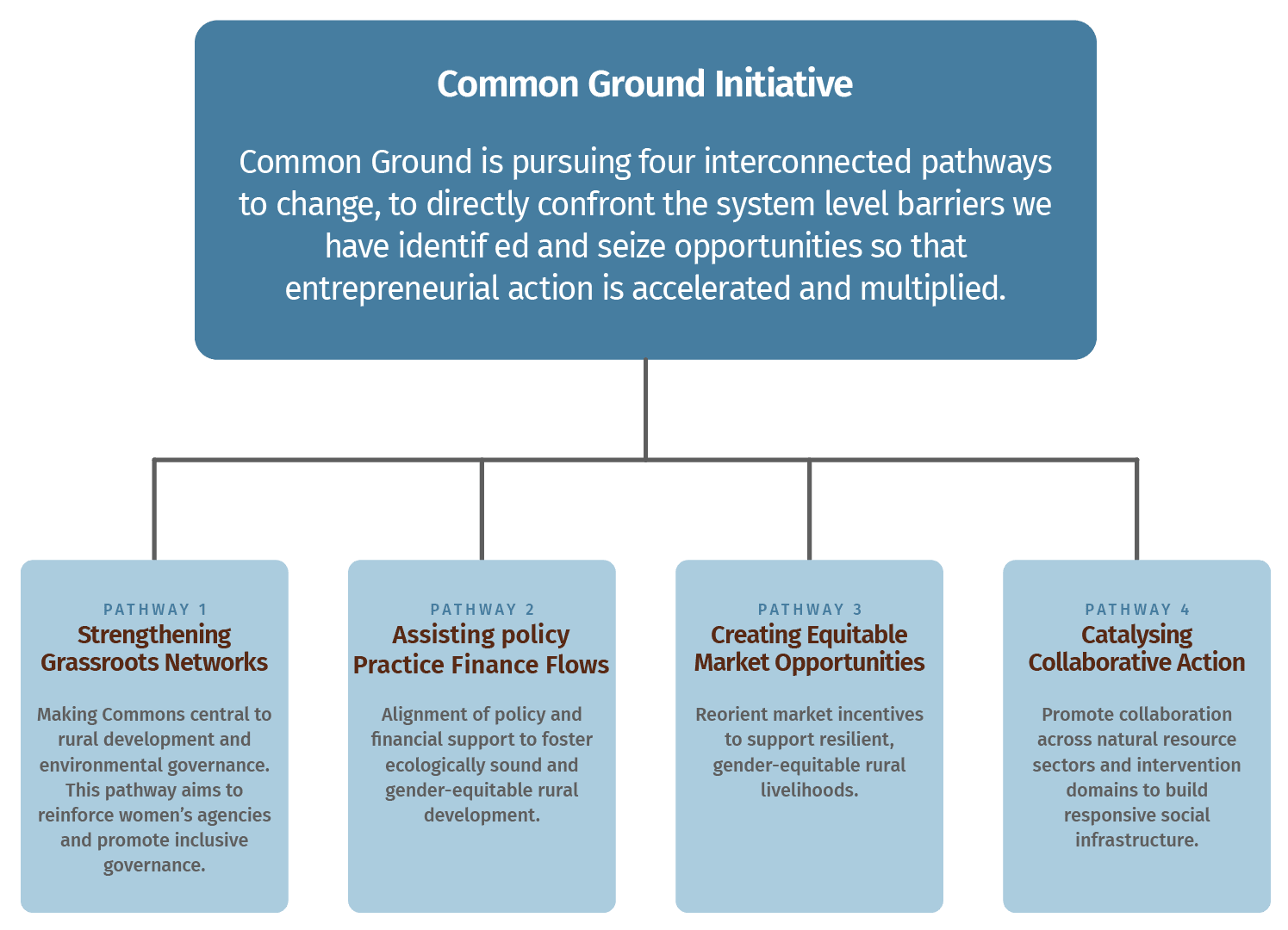
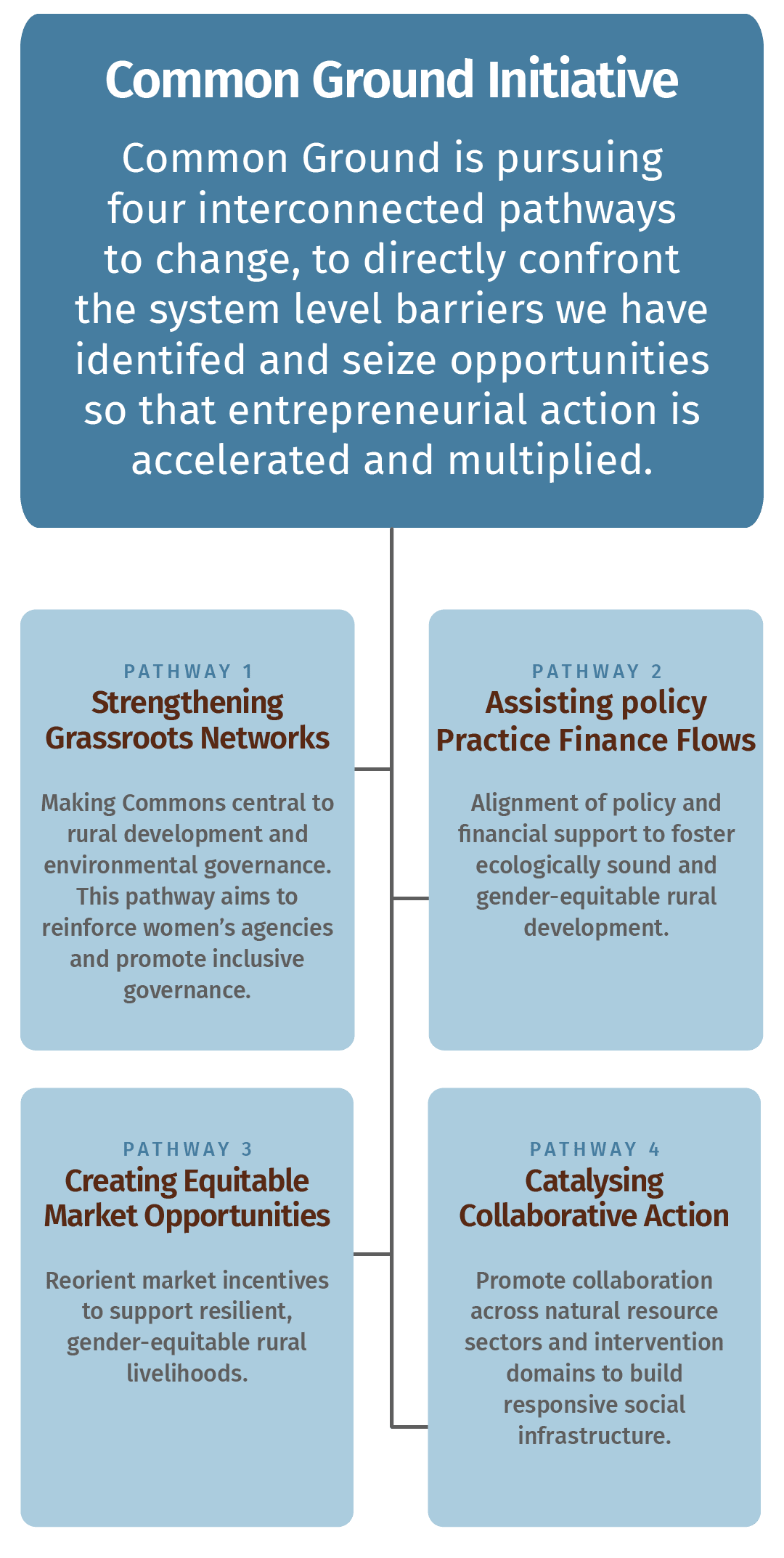
Common Ground adopts a two-pronged strategy:
Addressing the deeper structural shifts confronting environmental governance and rural livelihoods.
Nurturing a system-wide collaborative infrastructure to connect, convene, and align diverse actors for coherent action, finding ‘common ground’ even in the absence of full agreement
Collaborative Action Framework
A wide range of actors work on the Commons, but their efforts are often fragmented, limited in scope, isolated, and duplicated. The initiative’s five core intervention strategies will facilitate connectivity, co-development, and alignment among them.
Co-create Public Goods
Co-create critical resources that benefit the broader community and ecosystem.
Collective Championing
Connect different organisations to align and amplify efforts advancing common causes.
Convene Dialogue Platforms
Establish online and in-person spaces for stakeholders to engage on Commons-related issues.
Collective Learning
Establish forums and practices that aim to build a culture of learning and adaptation in the ecosystem.
Collaborative Orchestration
Ensure alignment and synergy among various initiatives to enhance their collective impact.
Targeted 5-year impact at the local level
Over the next five years, Common Ground aims to support community-led action across:
Over the next five years, Common Ground aims to support community-led action across:
22 million acres of forests, pastures, and other commons,
benefiting 75 million rural people — including at least 37 million women, 25 million Scheduled Tribe members, and 9 million from Scheduled Castes.
Equitable and durable gains reflected to achieve 30–50% income gains, through improved productivity from agriculture, livestock, forest produce, stronger value chains, and access to emerging opportunities such as carbon and biodiversity credits.
These outcomes are tied to the broader goal of restoring ecologically healthy commons, strengthening livelihoods, and building resilience to climate and economic stresses.
Our core principles
We jointly define and agree upon the set of principles that underpin participation in the Collaborative:
Plurality of approach with mutual respect
I may not necessarily agree with the approaches taken by all Working Groups to achieve outcomes, but I agree to disagree with mutual respect for one another.
Collective leadership with
participative governance
I will share responsibility as a partner in the Collaborative on a rolling basis and contribute at the highest level in strategic decision – making for the
Collaborative.
Proactive partnerships
I will proactively identify and engage with experts from the ecosystem to leverage existing capabilities and resources and not attempt to recreate the wheel.
Open knowledge sharing
I will ensure that the learnings from the Collaborative including assets, best practices and operational knowledge are shared with all Collaborative members and the broader ecosystem.
Diversity and inclusion
I will hold myself and the Collaborative accountable across all our structures and processes to ensure strong focus on gender equality and responsiveness to the communities we serve.
Collective accountability
I will take accountability for commitments that were aligned together at the Working Group level and subsequently made to stakeholders including governments and partners as my own.
Commitments under the Sustainable Development Goals (SDGs)
Common Ground contributes to India’s commitments under the Sustainable Development Goals (SDGs), the Paris Climate Accords, the Bonn Challenge for forest restoration, and the Convention on Biological Diversity. Through our work on strengthening decentralised governance, supporting Commons-based livelihood, and restoring ecological systems, the initiative helps embed ecological and social considerations into mainstream development planning and public investment frameworks.
No Poverty:
Strengthening rural livelihoods through community-led governance of commons
Gender Equality:
Placing women’s agency at the centre of ecological and economic decision-making
Decent Work and Economic Growth:
Supporting community enterprises, fair value chains, and dignified rural employment
Reduced Inequalities:
Reduced Inequalities: Enabling greater representation and voice for marginalised groups in decision-making
Climate Action:
Supporting nature-based solutions and climate-resilient landscapes
Life Below Water:
Coastal commons, such as mangroves, estuaries, and tidal wetlands, are central, as their community-led governance strengthens biodiversity, buffers climate impacts, and sustains livelihoods.
Life on Land:
Enabling conservation and sustainable use of land-based ecosystems
Partnerships For The Goals:
Building multi-actor collaborations across civil society, government, philanthropy, and markets