While the pace and scale of the unfolding crises—climate change, rural distress, and growing inequalities—are alarming. Government capacity, private sector incentives, technological reach to the ‘first mile’, and civil society influence are each insufficient to catalyse the change required.
We need to strengthen both – the ability of ecosystems to recover as well as people’s agency, especially women, tribal groups, and the rural poor, to reclaim their lands, shape their futures, and author their stories.
By catalysing, convening, and connecting actors within and across civil society, businesses, and governments, Common Ground will help build the connections, processes, and knowledge systems necessary for local communities to determine and shape their futures.
India’s Commons are degrading at a rate of 4% per year, endangering the livelihoods of forest dwellers, pastoralists, tribal communities, and women.
As access to food, water, fuel, and income declines, inequality deepens and climate risks rise. Customary systems of self-regulation, rooted in ecological balance and democratic practice at the local level, are eroding.
Strengthening these systems is vital not just for regeneration, but for informing institutional innovations in areas such as health, education, and technology.
Population Dependence
Over 350 million rural poor in India rely on common property resources for their livelihoods
Economic Value
Commons contribute around USD 90.5 billion (6.6 lakh crore) annually to the incomes of rural poor households
Land Area
Commons in India cover approximately 205 million acres
Self Governance
Commons are managed through self-regulatory local institutions such as Gram Panchayats, FRA committees, Van Suraksha Samitis, and Gram Sabhas that enable collective community decisions.
Understanding the barriers
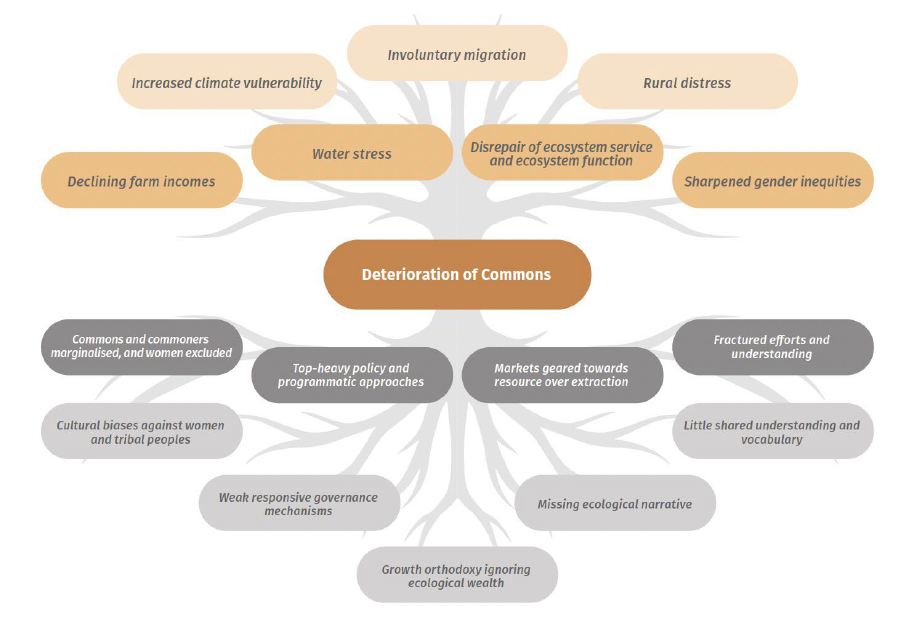
The development landscape is shaped by deep-rooted structural barriers, top-down approaches, and persistent biases that marginalise women, overlook local priorities, and devalue ecological needs (see problem tree). Government capacity, private sector incentives, tech access to the first mile, and civil society influence are each insufficient to catalyse the change required, especially in the absence of full agreement among actors.
Common Ground responds by strengthening the ecosystem’s collective ability to act—through collaboration, co-creation, and trust-building across diverse perspectives.
Despite clear links between the Commons and rural well-being, ecological and community priorities continue to be sidelined in development planning.
India faces a triple crisis of climate, rural livelihoods and equity that has been made worse by the COVID-19 pandemic. Failure to tackle these challenges endangers us all.
Ecological considerations and local priorities – especially those of women and marginalised communities – are de-prioritised in our drive for economic growth.
Collectively held shared resources are not protected by law in the same way that private or state – owned property is.
Many still question the ability of rural people, particularly women, to govern and manage resources.
Efforts by civil society, government, and markets remain fragmented and often at cross-purposes.
Government capacity, corporate incentives, digital outreach, and civil society efforts – on their own – have not been enough to bring lasting change on the ground.
The need for systemic change
With the climate crisis, livelihood crisis and equity crisis looming large, a consolidated approach that embeds the interconnections between them is urgently required.
Systemic change demands more than finance; it requires societal infrastructure for collective action.
Government capacity, private sector incentives, technological reach to the ‘first mile’, and civil society influence are each insufficient to catalyse change at the pace and scale required. We need an ‘ecosystem approach’ that connects and aligns diverse actors, even in the absence of full agreement, to address the interlinked challenges of rural livelihoods, equity, and environmental governance, to nurture large-scale systems change.