

How can coastal conservation, community rights, and livelihood security be pursued together? This question was central to the discussions at the Odisha Day, the state chapter of the 10th India Land and Development Conference (ILDC), held on 14 October at CYSD, Bhubaneswar. The dialogue brought together policymakers, community leaders, practitioners, and researchers to deliberate on how land, forest, and coastal governance in Odisha can become fairer and more resilient.
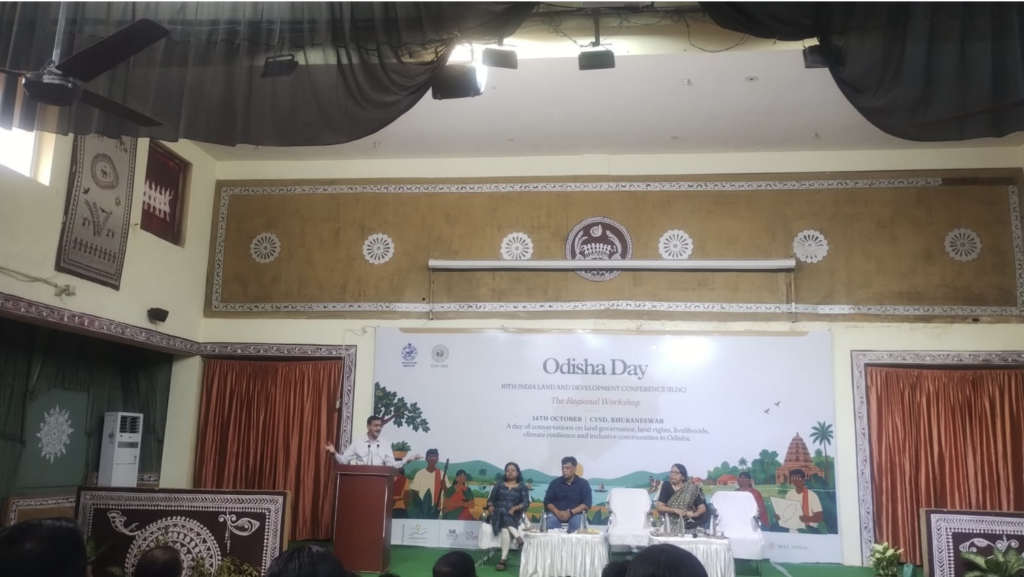
Across five technical sessions, participants explored themes spanning women’s land rights, tribal land rights, land leasing and tenancy, common land documentation, coastal commons and the rights of fishing communities, and urban liveability.
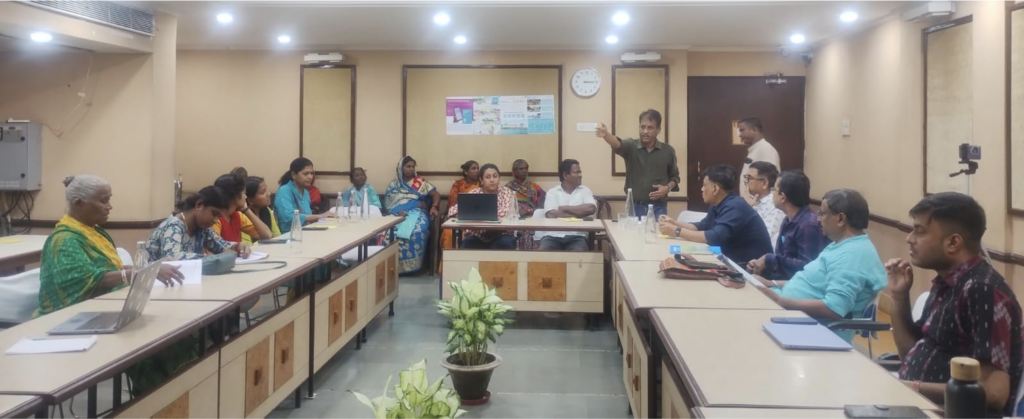
One of these sessions, co-organised by representatives from Centre for Research and Community Action, Common Ground, and Socratus Foundation for Collective Wisdom, brought together community leaders and representatives from Chilika, Kendrapada, Podampetta, and Puri, among others, to reflect on the state of Odisha’s coastal commons.
The discussions highlighted an important dimension of land and commons governance: the realities of traditional fishing communities, whose livelihoods, access to natural resources, and cultural identities are closely linked to coastal and wetland ecosystems. Coastal commons are governed by multiple, overlapping legal, ecological, and administrative frameworks, including the Coastal Regulation Zone (CRZ), estuarine and intertidal zones, the Exclusive Economic Zone (EEZ), continental shelves, and high- and low-tide lines. These complexities often make it challenging for local communities to understand, claim, and exercise their rights.
Drawing on experiences from Chilika lagoon, the Mahanadi delta, Bhitarkanika, Rushikulya, and the erosion-affected village of Podampetta, the session brought to the fore several interconnected challenges. The experiences shared also underscored why coastal issues cannot be addressed in isolation from questions of land tenure, local governance, livelihood security, and ecological sustainability.
1. What coastal communities are experiencing
Insecure tenure and diminishing access to coastal commons
Traditional fishing communities need access not only to fishing grounds but also to spaces for keeping boats, fishing nets, and other livelihood-related equipment. Yet, these spaces are often not captured in conventional commons mapping exercises.
Participants highlighted difficulties relating to land records, pauti, patta, and K-form pattas, as well as challenges in accessing government benefits because of inadequate or incomplete documentation. Some communities have lived in coastal areas for generations but continue to face difficulties establishing formal recognition and securing land tenure. Encroachment on shared spaces and other community-use areas, sometimes through tree plantations or land development undertaken without adequate community participation, further compounds these challenges.
In Chilika, traditional fisherfolk raised concerns about access to fishing grounds, the expansion of industrial fishing, and limited community representation in decision-making institutions. Participants also highlighted restrictions around dolphin habitats and the need for an accurate survey of the lagoon and its traditional users. These concerns reflect a larger challenge: customary access and community use of coastal resources are not always adequately recognised in formal resource governance arrangements.
Conservation restrictions and traditional fishing rights
Traditional fishing communities face multiple restrictions arising from conservation measures, seasonal fishing bans, wildlife protection, navigation requirements, competing commercial uses of water bodies, and reducing fishing days owing to rising weather events.
In Kendrapada and Bhitarkanika, seasonal restrictions in the coastal areas discussed include the olive ridley turtle conservation period, the monsoon fishing ban and restrictions associated with Bhitarkanika. While these measures serve important ecological purposes, their cumulative effect can significantly reduce the number of days available for fishing and income generation.
Coastal erosion, displacement, and loss of livelihoods
The experience of Podampetta in Ganjam brought into focus the devastating consequences of coastal erosion and climate-related displacement. Participants described successive episodes of erosion, including events around 2010 and after Cyclone Phailin in 2013, which resulted in the loss of homes and land and the relocation of affected families.
Although compensation and rehabilitation support were reportedly provided to some households, concerns remain about the lack of secure land titles at relocation sites, limited access to agricultural land and the absence of viable alternative livelihoods. Displacement has also affected more than physical shelter. It has disrupted community networks, access to the sea, traditional knowledge, food security, and the ability of future generations to maintain their livelihoods.
Pollution, industrialisation, and ecological degradation
Communities living near industrial and agricultural areas reported pollution-related concerns affecting both farming and fishing.
The discussions referred to the Mahanadi and other river systems, Chilika and its catchment, and the interactions between rivers, wetlands, and the sea. Pollution in upstream and riparian areas can affect downstream ecosystems and the livelihoods of communities dependent on fisheries, agriculture, and other natural resources. Participants also raised concerns about aquaculture and shrimp farming, including the need to enforce applicable environmental regulations and address potentially damaging practices. The health of coastal ecosystems, thus, is closely linked to activities and governance arrangements across the larger landscape.
Livelihood insecurity, migration, and gendered impacts
The erosion of natural-resource-based livelihoods, combined with fishing restrictions, landlessness, and pollution, has increased livelihood insecurity. Migration was discussed as both a coping strategy and a consequence of inadequate livelihood opportunities in coastal villages. Participants also highlighted the lack of secure documentation, limited access to government schemes, and barriers to finance and entrepreneurship.
Women, including fisherwomen involved in processing, marketing, and other fisheries-related activities, are also affected by the decline in access to common resources, but their contributions and losses are not always adequately reflected in existing compensation and rehabilitation mechanisms. The particular vulnerabilities of landless households and marginalised communities, including Bawri and Kela communities, were also highlighted.
Participants questioned why compensation mechanisms available for certain agricultural losses do not adequately address livelihood losses experienced by traditional fishers during cyclones, severe weather events and prolonged fishing restrictions. Beyond income losses, participants emphasised the need to recognise non-economic losses and damage, including the loss of homes, cultural practices, traditional knowledge, community networks and psychological well-being.
2. What would a more inclusive approach to coastal commons governance look like?
The discussions highlighted the need to move beyond addressing individual challenges in isolation. The following priorities emerged:
Recognising customary rights and strengthening local governance
- Explore a dedicated legal and policy framework for coastal commons and traditional fishing communities, drawing lessons from the Forest Rights Act while accounting for the distinct legal and ecological context of coastal areas.
- Recognise traditional fishing areas and customary access to boat-landing sites, intertidal spaces, fishing grounds, and equipment-storage areas.
- Strengthen commons mapping through participatory processes, ensuring that Gram Sabhas and local communities are involved in identifying and validating customary-use areas.
- Address pending land-tenure and rehabilitation issues, including the regularisation of eligible K-form pattas and access to relevant government schemes.
- Strengthen local governance and Panchayati Raj institutions in coastal resource management.
Balancing ecological conservation with community livelihoods
- Ensure that conservation measures are informed by community participation, sound ecological evidence, and transparent decision-making.
- Undertake updated surveys of Chilika and other important coastal and wetland commons, including traditional fishing areas and community dependence on these resources.
- Strengthen representation of traditional fishers, including fisherwomen, in the Chilika Development Authority and other relevant decision-making bodies.
- Review the implementation of applicable judicial directions and environmental regulations concerning aquaculture and ecologically damaging fishing practices.
- Develop livelihood-support and compensation mechanisms for periods when fishing is restricted for conservation or disaster-related reasons.
Strengthening ecological restoration and promoting responsible investment
- Strengthen monitoring and accountability for industrial discharge, agricultural runoff, saline-water intrusion, and aquaculture-related pollution.
- Adopt a landscape-based approach linking rivers, riparian zones, wetlands, estuaries, and coastal ecosystems.
- Promote mangrove restoration and other locally appropriate ecosystem-based adaptation measures, with community participation.
- Ensure that tourism, transport, and commercial fishing are regulated in ways that protect coastal ecosystems and safeguard traditional livelihoods.
Building livelihood resilience and comprehensive social protection
- Develop compensation and insurance mechanisms for fishing-related livelihood losses arising from cyclones, extreme weather, conservation bans, and other disruptions.
- Explore trigger-based or parametric insurance linked to verified weather data and clearly defined eligibility criteria.
- Recognise non-economic loss and damage, including displacement, loss of customary access, cultural disruption and mental-health impacts.
- Ensure that women and other vulnerable members of fishing households are recognised in compensation and rehabilitation frameworks.
- Improve access to identity documents, marine fishing cards, pensions, subsidies, and other relevant entitlements.
- Support context-appropriate livelihood diversification, including integrated farming, suitable alternative crops, seaweed cultivation, crab-related livelihoods, and other locally viable options.
- Provide skills development and entrepreneurship support for coastal youth and households affected by erosion, pollution, and fishing restrictions.
- Ensure that alternative livelihood programmes are adequately funded and designed with communities rather than introduced as one-size-fits-all solutions.

0 Comments