
By Thomas Isaac, Former Finance Minister, Government of Kerala
In Kerala, we have spent the last three decades charting an ambitious journey of democratic decentralisation. As someone deeply involved in shaping these processes, both as an academic and as a policymaker, I have witnessed firsthand how empowered local governments and active community participation can transform the management of natural resources, public services, and local commons.
At its core, the Kerala model rests on a simple idea: local communities must play a central role in managing local resources. Commons have historically been owned, used, and regulated by the people who depend on them. Over time, however, rapid urbanisation, market pressures, and top-down governance alienated communities from their commons. Kerala’s approach seeks to reverse that by bringing governance closer to the people.
From Representative to Participatory Democracy
The passage of the 73rd and 74th Constitutional Amendments provided the foundation for local self-governance across India, including in scheduled and tribal areas. In Kerala, we went a step further by empowering gram sabhas and creating multiple participatory fora where people could directly shape decisions about schools, hospitals, agriculture, and local services like anganwadis.
The aim was clear: governance should not be a mere formality. When people collectively decide how resources are used, accountability deepens and outcomes improve. The results have been remarkable. Kerala is the only state where every locality has developed a Biodiversity Register, mapping species, ecosystems, and community interactions. Building on this, we are now moving towards action programmes that not only document but also restore and enhance biodiversity.
Local Governments at the Heart of Crisis Management
Kerala’s experiment with decentralisation has truly been tested during times of crisis. In 2018, the state witnessed one of its worst floods in a century. I was in Alleppey, a region below sea level known for its paddy fields. The rising waters displaced tens of thousands of people overnight. Yet, thanks to the local governments’ deep familiarity with community vulnerabilities, 50,000 residents were evacuated without a single casualty.
Similarly, during the Covid-19 pandemic, panchayats and municipalities became frontline responders, setting up quarantine facilities, ensuring essential supplies, and mobilising volunteers. These experiences have since led every local body in Kerala to prepare its own disaster management and mitigation plan, embedding environmental conservation and community resilience into local governance.
Towards Net-Zero Panchayats
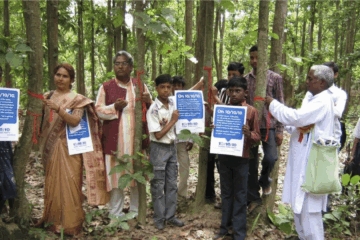
Out of this learning emerged an inspiring movement: Net-Zero Emission Panchayats. The journey began in Wayanad, where one panchayat decided to become carbon-neutral by a set date. A scientific audit of emissions, carbon sequestration capacities, and local practices led to a tree banking programme, supported by local banks providing loans for tree planting with annual returns linked to tree survival.
This innovation caught national attention, even being mentioned by the Prime Minister. Today, multiple panchayats across Kerala are adopting similar approaches, showing how climate action can be locally rooted, financially sustainable, and community-driven.
Why Platforms Like Commons Convening Matter
Kerala’s experience is one story among many. Across India, diverse communities have evolved traditional systems of Commons management, from forest-dependent tribal groups to coastal fishing collectives. These practices vary by geography, culture, and ecology, but they share a common principle: self-regulation rooted in community knowledge.
However, today, global market forces and unplanned development increasingly threaten the Commons. Platforms like the Commons Convening play a critical role in bringing together these diverse experiences, enabling learning across regions and helping us remodel traditional practices for contemporary realities.
Kerala’s journey shows that when local governments and communities converge, commons are better protected, crises are better managed, and environmental goals become achievable. But this is not Kerala’s story alone, it’s a vision for India’s future: building participatory, resilient, and sustainable local governance systems that place communities at the heart of decision-making.